
Myth Busting – Did a Tycoon Really pay Off an Animal Rescuer’s Mortgage So He Could Keep Saving Strays?

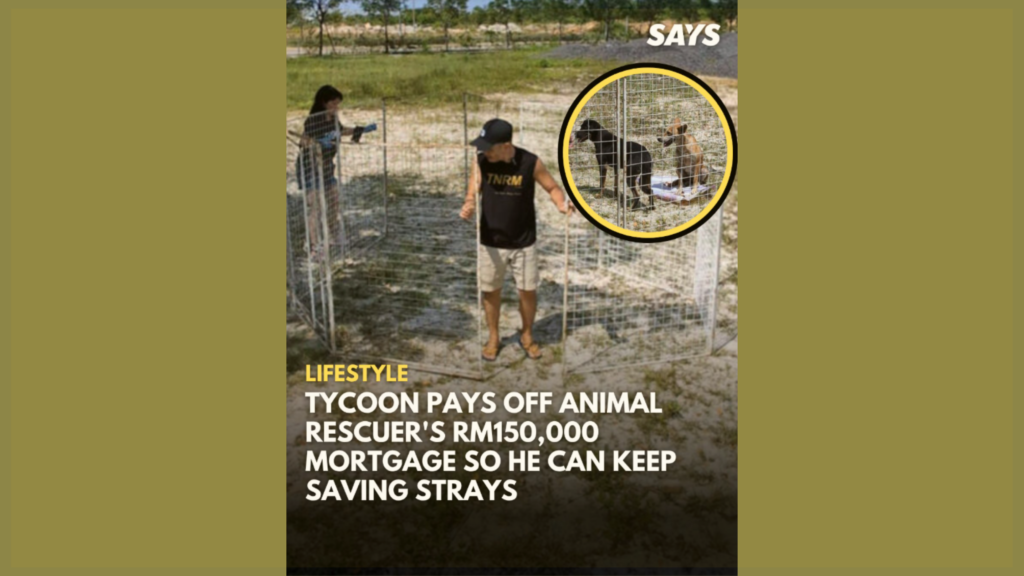
A viral story out of Malaysia claims that a wealthy businessman paid off an animal rescuer’s RM150,000 (just over $37K USD) mortgage so he could continue rescuing and neutering stray dogs and cats full-time. Social media often frames it as a feel-good legend — generous tycoon, struggling rescuer, instant miracle. In this case, the story is not a myth. It’s real, documented, and far more nuanced than the viral versions suggest.
What Actually Happened
The rescuer at the center of the story is Stuart Tan, co-founder of Trap-Neuter-Release-Manage (TNRM) Malaysia, a long-running NGO focused on humane stray population control. The account was reported in detail by Malaysian outlet SAYS.com, which spent time embedded with TNRM during active neutering operations and published first-hand interviews, photos, and financial context.
According to Tan, a low-profile property developer he had met only once initially offered to fund a salaried position so someone could manage neutering work full-time. When no suitable candidate emerged, Tan proposed an alternative: instead of paying a salary, the donor could help cover his mortgage so Tan could leave his piano teaching job and commit fully to TNRM’s work.
Tan expected small, monthly assistance. Instead, the following day, the businessman returned with a cheque for RM150,000, paying off Tan’s mortgage in full. This occurred gradually over the organization’s early years, with the mortgage officially cleared in 2018 — not overnight, and not as a publicity stunt.
Was This a One-Off or Part of a Larger Pattern?
While this specific mortgage payoff is unusual in its scale, it is not entirely unique in the animal welfare world. Across Malaysia — and globally — there are documented cases of private individuals quietly funding rescues, paying medical bills, underwriting spay/neuter programs, or covering personal living costs so rescuers can work full-time. What makes this case stand out is its transparency and documentation, not necessarily its existence.
In Malaysia specifically, long-term donor-rescuer relationships are common due to limited government support for stray management. However, no other publicly verified cases have surfaced where a donor paid off a rescuer’s personal mortgage in a single, clearly documented arrangement like this one.
Why the Story Resonated – and Can Get Distorted
The viral versions often simplify the story into a fairy tale: tycoon appears, rescuer is “saved,” animals benefit. The reality is more grounded. Tan had already been running TNRM for years, working in extreme heat, coordinating volunteers, partnering with feeders, publishing receipts publicly, and demonstrating consistent impact. The donor’s decision came after observing sustained effort, not as an impulsive act.
That distinction matters. It reframes the story from luck to trust — and from charity to long-term investment in humane animal management.
Why This Matters Beyond Malaysia
This story highlights an often-overlooked truth in animal welfare: spay and neuter work is labor-intensive, emotionally exhausting, and chronically underfunded. When rescuers burn out or cannot afford to continue, entire communities feel the impact through rising stray populations, shelter overcrowding, and preventable suffering.
Strategic financial support — whether through donors, grants, or policy — doesn’t just help one rescuer. It stabilizes systems. In Tan’s case, the ability to work full-time helped TNRM consistently neuter 50–60 animals per month, with peaks as high as 160 animals in a single month when funding allowed.
The Bottom Line
Yes, the story is true. A Malaysian businessman did pay off an animal rescuer’s RM150,000 mortgage so he could continue saving strays through humane, science-backed methods. What social media often leaves out is the years of work that earned that trust, the transparency behind the NGO, and the larger lesson: sustainable rescue work doesn’t happen on goodwill alone — it happens when people invest in people who have proven they’ll show up, day after day, in the heat, for animals who have no voice.