Rescue Tech Spotlight: Buzz to the Rescues’ Approach to Animal Rescue Management Software
Published July 30, 2026
Animal rescue technology has evolved from simple animal databases into systems designed to manage much of the work surrounding an animal’s journey through a shelter or rescue. Today’s platforms may handle everything from intake and medical records to adoption applications, foster coordination, fundraising, reporting and public-facing adoption listings.
Rescue Tech Spotlight
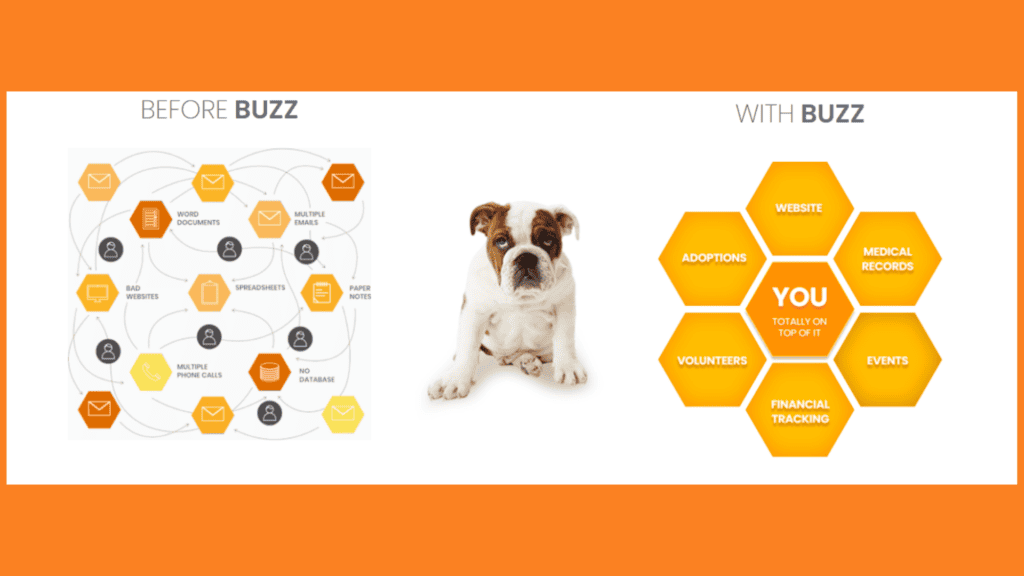
For organizations operating with small staffs and large volunteer networks, the challenge is often not a lack of technology but too many systems. A rescue may have one platform for animal records, another for its website, another for applications and another for donations, with volunteers or staff responsible for keeping information synchronized. Buzz to the Rescues takes a different approach: putting those functions into one connected platform.
How Shelters and Rescues Use Buzz to the Rescues
Buzz to the Rescues is designed to follow an animal through the rescue process, beginning with intake and continuing through care and outcome. Animal profiles can include medical information, behavior, feeding and routine details, documents, foster assignments, scheduled activities and communications.
The platform also connects the people surrounding an animal. Adoption, foster and volunteer applications can be customized, with conditional questions and automatic creation of profiles when an application is submitted. Organizations can assign application reviewers, track verification information and maintain communications within a shared timeline.
For fosters, access can be controlled at a granular level, allowing organizations to determine what volunteers can see or edit. Animals can be moved between foster placements, while scheduled veterinary appointments, transports, training and meet-and-greets remain connected to the animal’s record.
Buzz also extends beyond adoption. Its website and forms can support owner surrenders, rehoming assistance, food programs, financial assistance, clinics and TNR programs. That broader functionality is notable because it treats rescue management as more than tracking animals that are currently available for adoption.
For a Nevada rescue balancing foster homes, community programs and adoption activity, having those functions in one database could reduce the number of places volunteers need to look for information.
What Makes Buzz to the Rescues Different
Buzz’s most defining characteristic is its all-in-one model. The company says its platform replaces multiple tools with one system covering animal management, community management, fundraising, data and reporting, and a connected website.
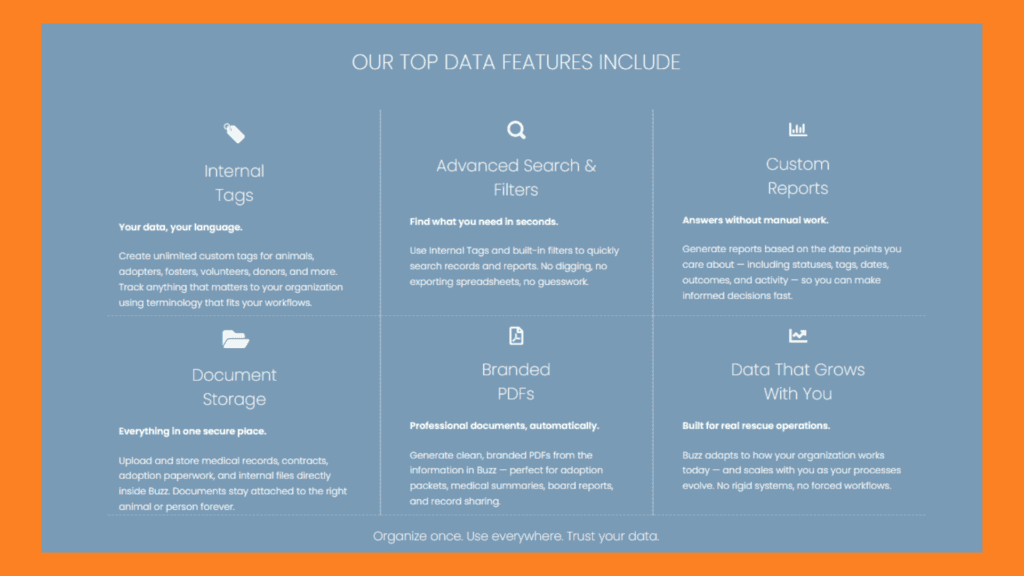
Some of its more distinctive features are relatively small operational tools. Internal Tags, for example, allow organizations to create their own private labels for animals, fosters, adopters and volunteers. A rescue could use them to identify medical needs, training requirements, foster availability or transportation status and then use those tags in reports.
The platform also supports up to 135 verification data points for adoption applications, according to Buzz, allowing organizations to track items such as landlord approval or fencing information. Documents can be generated automatically from existing records, including adoption contracts, medical histories, kennel cards, receipts and certificates.
The emphasis is on turning information entered once into information that can be reused throughout the organization.
That can be valuable, but it also means the rescue has to decide what information it wants to capture and how it wants to organize it. Flexibility does not remove the need for thoughtful setup.
Ease of Use and the People Behind the Platform
Buzz was created by The Buzz Group, Inc., which says it spent 15 years developing digital solutions before moving its focus to animal rescue technology. According to the company, the transition began after a woman involved with a golden retriever rescue approached the company about connecting her website with animal management software.
That experience reportedly prompted the company to focus exclusively on rescue technology, with an emphasis on making the software usable by people without technical backgrounds.
Buzz provides onboarding, training and ongoing standard support. Its Launch Pack includes website development, application customization, data migration and training.
The platform is designed for rescue teams rather than a single administrator, with unlimited users and customizable permissions included in the subscription. That matters for organizations where responsibility moves between staff members and volunteers.
Still, no management platform is completely hands-off. Buzz’s own migration process requires the rescue to provide its existing data, and organizations must establish their own tags, applications and workflows. For a small rescue, the time required to configure a new system can be a meaningful part of the investment even when the software itself is straightforward to use.
Integration and Compatibility
Buzz is built to connect with several of the services commonly used by rescues. Its listed integrations include Petfinder and Adopt-a-Pet, Buddy ID and AKC Reunite, PayPal and Stripe, Mailchimp, Constant Contact and Brevo, along with several fundraising and other services.
When connected, changes made in Buzz can flow to external platforms. For example, an animal’s availability can update on the rescue’s website and, through the applicable integrations, on Petfinder and Adopt-a-Pet.
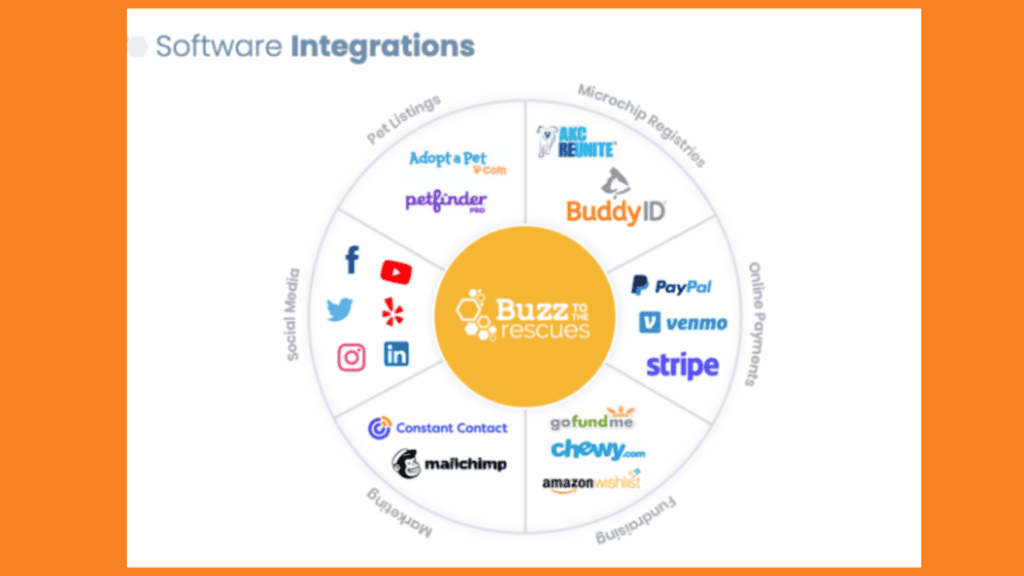
This is one of the strongest arguments for an integrated system: the potential to eliminate duplicate data entry.
There is an important distinction, however. Buzz’s website is part of its platform. Organizations using the full system use what Buzz calls the “Buzz version” of their website, built and hosted within its environment. The company says rescues retain ownership of their domain, content, logo, data and other assets they bring to the project, while Buzz retains its themes and the underlying site files and design.
Buzz also states that its themes require Buzz hosting. If an organization leaves, the company says it will assist with exporting data and site content, but the actual site files, including the design, remain with Buzz.
For a rescue considering the platform, that makes website portability an important part of the technology decision, not simply a website design question.
Funding the Platform: How Buzz Makes Money
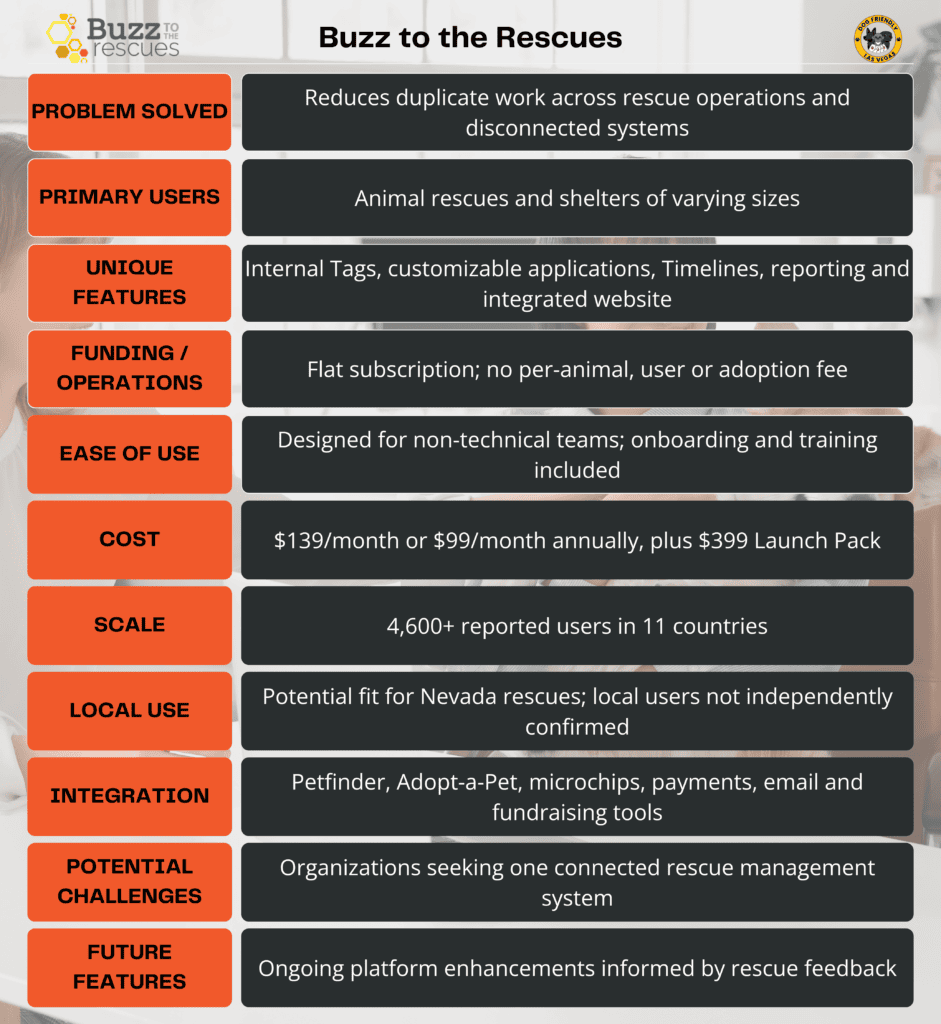
Buzz uses a subscription model rather than charging based on the number of animals, users or adoptions.
Its published price is $139 per month, or $99 per month when billed annually. Annual billing is $1,188. Buzz also lists a $399 Launch Pack for website creation, application customization, data migration and training.
The company says there are no per-animal fees, per-user fees, adoption fees or percentage taken from donations. Hosting, security, platform updates, standard support and training are included.
There are still costs outside the subscription. Payment processors charge their own transaction fees, and email service is not included. Buzz says organizations can use services such as Google Workspace for nonprofit email and can select from multiple payment and fundraising providers.
For perspective, a processor charging 2.9% plus $0.30 would cost about 59 cents on a $10 transaction and $1.75 on a $50 transaction. Actual nonprofit rates vary, so rescues should use their own processor’s pricing when calculating total cost.
Buzz also states that custom development, advanced design changes, complex reports and other non-standard requests may carry additional fees.
Cost, Scale and the Value of Time
At $1,188 annually when paid yearly, Buzz is not an insignificant expense for a small, volunteer-run rescue. But comparing that number with a website subscription alone misses the point of the platform.
A rescue considering Buzz would need to compare its current costs for animal management software, website hosting, forms, fundraising tools, reporting, email and other services, along with the volunteer or staff time spent maintaining them.

For example, if a volunteer spends several hours each week moving information between systems, updating adoption listings, maintaining spreadsheets or troubleshooting disconnected tools, that time has an organizational cost even if no one receives a paycheck for it.
At just three hours per week, that represents more than 150 hours a year. At five hours, it approaches 260 hours. The value of those hours depends on the organization, but they could instead be spent coordinating fosters, processing adoptions, fundraising, supporting adopters or addressing animals’ needs.
That calculation will look very different for a small rescue using free nonprofit tools than it will for a larger organization already paying for several systems.
Buzz reports more than 4,600 users in 11 countries. Those figures are company-reported and do not establish how many of those users are Nevada organizations. We were unable to independently confirm a Nevada customer base from the information available to us.
Limitations and Considerations
The all-in-one model is also the primary tradeoff.
A rescue that already has a well-established website, specialized software and integrated fundraising systems may not benefit enough from moving everything into one platform to justify the disruption of changing systems.
The website relationship deserves particular attention. Buzz provides the website as part of its platform and requires its themes to remain hosted by Buzz. While the organization retains its data and content, the website design and underlying site files do not transfer if the rescue leaves.
Buzz also acknowledges limits to customization. Its team says it will make reasonable efforts to customize websites, but its primary focus is developing functionality for the broader platform. Advanced or non-standard work may cost extra.
That makes Buzz potentially more compelling for an organization looking for a managed, connected ecosystem than for a rescue that wants complete independence over its technology stack.
Future Opportunities for Rescue Technology
Buzz’s approach reflects a broader direction in animal welfare technology: bringing operational data together so that one action can support several parts of the organization.
The next opportunity is likely not simply adding more features, but making existing information increasingly useful. Better reporting, automation and connected records can help organizations understand where animals are in their processes, where applications are getting delayed, which foster resources are available and how programs are performing.
For Nevada’s geographically dispersed rescue community, technology that helps organizations coordinate people, animals and information across foster homes and communities could have particular value. The technology itself, however, remains only as useful as the information and workflows an organization puts into it.
Why It Matters
Buzz to the Rescues is built around a straightforward proposition: rescue organizations should spend less time managing disconnected administrative systems and more time using that information to support animals and people.
Its strongest potential advantage is not any single feature. It is the connection between them. An animal record can feed an adoption listing, an application can create an adopter profile, a document can pull from existing data, and a status change can flow to external adoption sites.
For a rescue starting from scratch or struggling with multiple disconnected systems, that consolidation may be worth the monthly investment. For an organization with a highly customized technology ecosystem, the decision is more nuanced.
The right question for any rescue considering Buzz is therefore not simply whether it has enough features. It is whether bringing those functions together will save enough time, reduce enough administrative friction and improve enough organizational visibility to justify the cost and the tradeoffs.
Quick View & Summary
Category: Animal Rescue Management Software
Your feedback helps us cover this better next time.
Sorry to hear that — what was missing?
Glad it helped!
Get the latest dog events and top stories delivered straight to your inbox.
Content reflects individual opinions for general information only and is not a substitute for professional care; Dog Friendly Las Vegas is not responsible for actions taken based on this content.